
PN16

TLV SS3-E, SS3-P, and SS3-EP free float clean steam traps in stainless steel. Designed for reactors, fermenters, and sterilizers up to 0.6 MPaG.
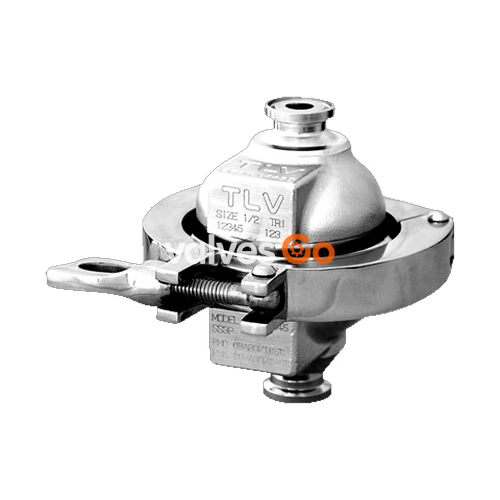
The TLV SS3-E, SS3-P, and SS3-EP are free float clean steam traps made of stainless steel, recommended for use in reactors, fermenters, and sterilizers in the chemical, pharmaceutical, food, and beverage services. They are suitable for a wide range of medium-capacity applications up to 0.6 MPaG (85 psig) requiring high levels of sanitation. The traps discharge condensate continuously and automatically at a temperature slightly lower than saturation temperature.
| Model | SS3-E | SS3-P | SS3-EP |
|---|---|---|---|
| Connection | Clamp End | Clamp End | Clamp End |
| Size | DN 15, 20 (ISO) / 1/2", 3/4" (ASME-BPE) | DN 15, 20 (ISO) / 1/2", 3/4" (ASME-BPE) | DN 15, 20 (ISO) / 1/2", 3/4" (ASME-BPE) |
| Maximum Operating Pressure (PMO) | 6 barg | 6 barg | 6 barg |
| Maximum Differential Pressure (ΔPMX) | 6 bar | 6 bar | 6 bar |
| Maximum Operating Temperature (TMO) | 165 °C | 165 °C | 165 °C |
| Clamp type | 3-piece (buff-polished) | 3-piece (buff-polished) | 3-piece (buff-polished) |
| Finishing (Internal) | 25µm Ra electro-polished | 0.8µm Ra buff-polished | Buff-polished then 0.4µm Ra electro-polished |
| Finishing (External) | 25µm Ra electro-polished | 25µm Ra electro-polished | Buff-polished then 0.4µm Ra electro-polished |
INFO
Pressure Shell Design Conditions (Not Operating Conditions):
| No. | Description | Material | DIN | ASTM/AISI |
|---|---|---|---|---|
| 1 | Body | Cast Stainless Steel A351 Gr.CF3M | 1.4435 | - |
| 2 | Cover | Cast Stainless Steel A351 Gr.CF3M | 1.4435 | - |
| 3 | Float | Stainless Steel SUS316L | 1.4404 | AISI316L |
| 4 | Body Clamp | Cast Stainless Steel A351 Gr.CF8 | 1.4312 | - |
| 5 | Cover Gasket | High-performance Fluorine Resin | - | - |
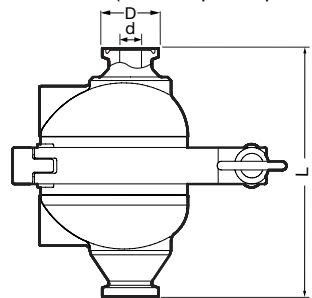
| DN | L (mm) | W (mm) | B (mm) | φD (mm) | φd (mm) | Weight (kg) |
|---|---|---|---|---|---|---|
| 15 (1/2") | 105 | 105 | 125 | 34 (25) | 15.2 (9.4) | 1.4 (1.3) |
| 20 (3/4") | 105 | 105 | 125 | 34 (25) | 19.3 (15.75) | 1.4 (1.3) |
( ) ASME-BPE (Tri-Clamp compatible)
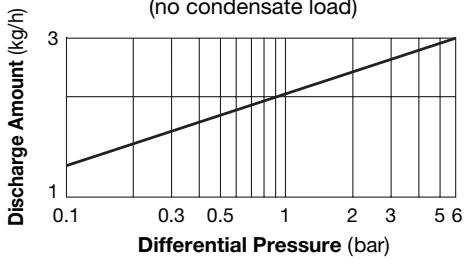
The SS3-P Clean Steam Trap has a small built-in drain hole to ensure no condensate remains in the trap after operation. Therefore, a minimum condensate load is required during operation to prevent any steam discharge. The chart below shows the maximum steam discharge through the drain hole under no condensate load conditions.
WARNING
DO NOT use traps under conditions that exceed maximum differential pressure, as condensate backup will occur! Recommended safety factor: at least 1.5.
A visual inspection can be carried out to aid in determining the necessity for immediate maintenance or repair, if the trap is open to atmosphere. If the trap does not discharge to atmosphere, use diagnostic equipment such as a stethoscope or thermometer.
| Status | Description |
|---|---|
| Normal | Condensate is discharged continuously with flash steam and the sound of flow can be heard. |
| Blocked | No condensate is discharged. The trap is quiet, making no noise, and the surface temperature of the trap is low. |
| Blowing | Live steam continually flows from the outlet and there is a continuous metallic sound. |
| Steam Leakage | Live steam is discharged through the trap outlet together with the condensate, and there is a high-pitched sound. |
Operational inspections should be performed at least twice per year, or as called for by trap operating conditions. Steam trap failure may result in a temperature drop in the equipment, poor product quality or losses due to steam leakage.
| Part | Inspection Item |
|---|---|
| Cover Gasket | Check for warping or damage |
| Float | Check for scratches, foreign matter, oil film, or liquid inside the float |
| Body and Cover Interior | Check for foreign matter build-up, oil film, scratches and wear |
| Orifice and Drain Hole | Make sure openings are not plugged with foreign matter |
| Part & No. | During Disassembly | During Reassembly |
|---|---|---|
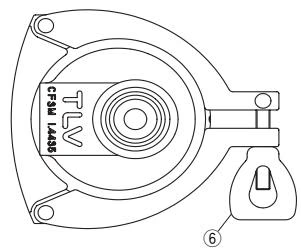
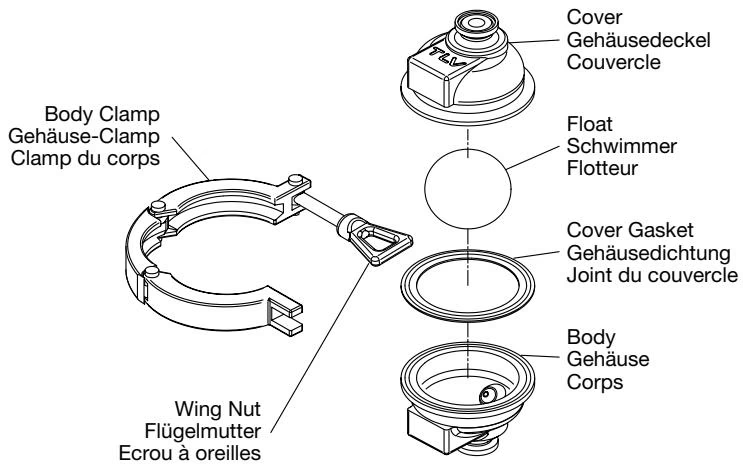
| Body Clamp (4) | Loosen the wing nut then remove the body clamp | Tighten wing nut to the proper torque (10 N·m); open inlet valve and allow live steam to enter and heat the trap, then close the inlet valve; after the internal and atmospheric pressures have equalized and the trap surface has cooled, tighten wing nut to the proper torque again. Steam may leak if wing nut is not re-tightened. |
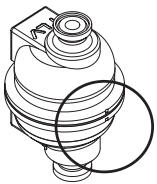
| Cover (2), Body (1) | Take apart without scratching the gasket sealing surfaces | With gasket in place, align grooves (fig. A) and gently place the upper body on the lower body |
| Cover Gasket (5) | Remove being careful not to scratch sealing surfaces | Replace with a new gasket if damaged |
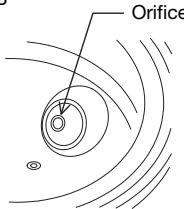
| Float (3) | Remove being careful not to scratch the polished surfaces of the float and the body | Insert into the body, being careful not to scratch its polished surface, take care not to scratch or damage the orifice (fig. B) |
| Problem | Cause | Remedy |
|---|---|---|
| No condensate is discharged or discharge is poor (blocked) | The float is damaged or filled with condensate | Replace with new float |
| The float is sticking to the orifice | Clean parts | |
| The orifice, drain hole or piping are clogged with foreign matter | Clean parts | |
| Steam-locking has occurred | Perform a bypass blowdown or close the trap inlet valve and allow the trap to cool | |
| Flow exceeds trap's rated capacity | Check specifications and reselect trap suitable for actual flow | |
| The trap operating pressure exceeds the maximum specified pressure, or whether there is insufficient pressure differential between the trap inlet and outlet | Compare specifications and actual operating conditions | |
| Steam is discharged or leaks from the outlet (blowing) (steam leakage) | Foreign matter has accumulated around the orifice or under the float | Clean parts |
| Scratches on the orifice | Replace lower body | |
| The float is deformed or has build-up | Clean or replace float | |
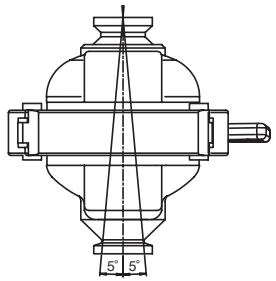
| Trap is installed above the maximum allowable inclination angle | Correct the installation | |
| Trap vibration | Lengthen inlet piping and fasten securely | |
| Steam is leaking from a place other than the outlet | Gasket deterioration or damage | Replace with new gasket |
| Improper tightening torque was used on the body clamp wing nut | Tighten to the proper torque | |
| Float frequently becomes damaged | Water hammer occurs | Study and correct the piping |
| Some condensate is held in the trap | The small drain hole is blocked or clogged with foreign matter | Clean |