
Skip to content
Wide ApplicationCompact & LightweightEconomicalLarge Filtration AreaDurable MaterialsCustomizable Screen

SY-5 Strainer

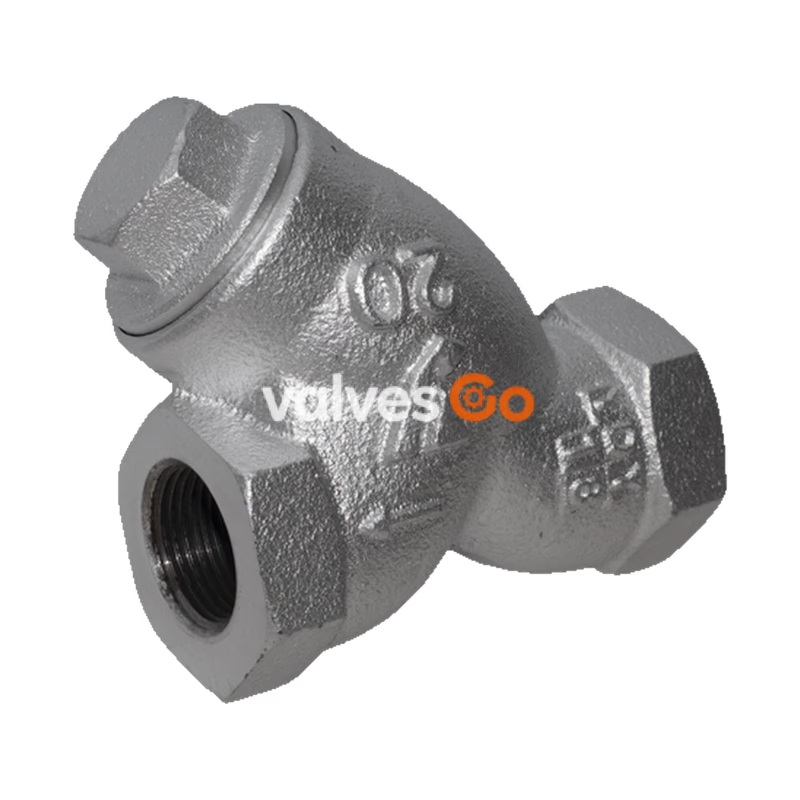
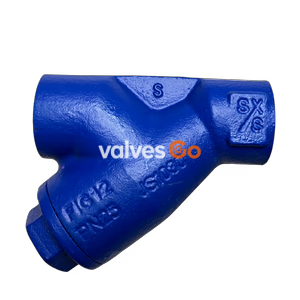
Yoshitake SY-5 Strainer is suitable for steam, air, hot/cold water, oil, and other non-hazardous fluids. Widely installed upstream of pressure reducing valves, temperature control valves, and other valves to protect equipment. Compact, lightweight, and economical with enlarged filtration area to reduce clogging impact. Features ductile cast iron body and stainless steel screen, JIS Rc threaded connection, nominal diameter range 10A-50A, meeting various pipeline filtration needs.

Product Overview

Yoshitake SY-5 Strainer is an economical filtration device designed for dust removal needs in various piping systems. It is especially suitable for installation upstream of pressure reducing valves, temperature control valves, solenoid valves, steam traps, and other valves to extend downstream equipment lifespan from protection and maintenance perspectives. The product features wide application and compact, lightweight design, with enlarged filtration area to address flow reduction caused by clogging, ensuring smooth fluid passage.

Technical Specifications

Basic Parameters

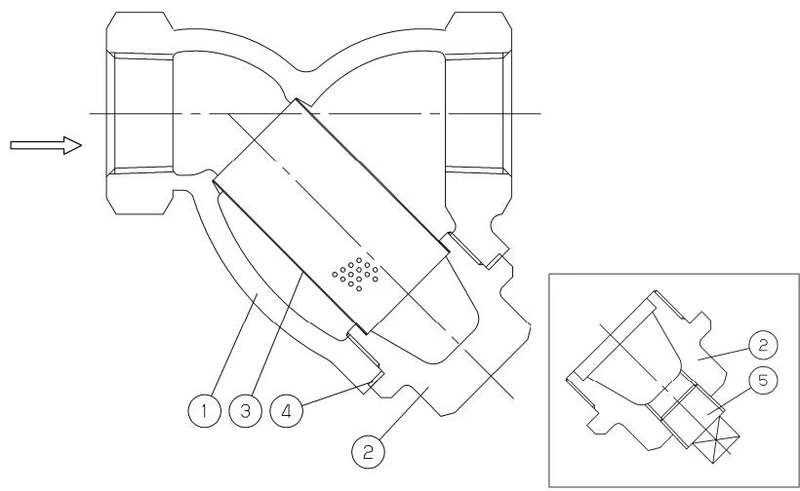
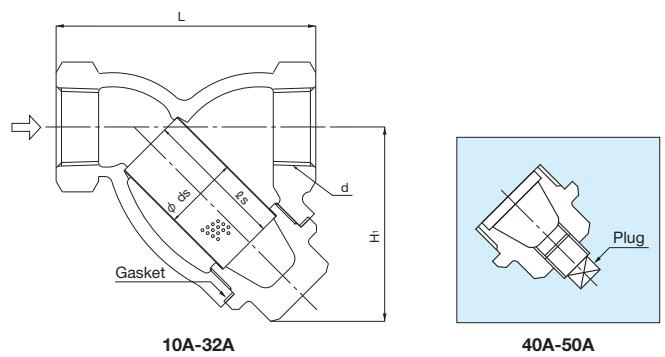
Yoshitake SY-5 Strainer - Structure Diagram

ParameterSpecification
Applicable FluidSteam, Air, Hot/Cold Water, Oil, Other Non-hazardous Fluids (SY-6 recommended for hot/cold water)
Max Pressure2.0 MPa
Max Temperature220°C
Body MaterialDuctile Cast Iron
Screen MaterialStainless Steel
Standard Screen Spec80 mesh (hole count: 2.5-7.21 holes/cm²)
Customizable Mesh20-100 mesh
Customizable Hole Count1.2-23.8 holes/cm²
Connection TypeJIS Rc Threaded
Pressure Loss ControlRecommended below 0.1MPa

Nominal Diameter and Thread Specifications

Nominal DiameterThread Spec (d)
10ARc 3/8
15ARc 1/2
20ARc 3/4
25ARc 1
32ARc 1-1/4
40ARc 1-1/2
50ARc 2

Dimensions and Weight

Yoshitake SY-5 Strainer - Dimensions

Nominal DiameterThread Spec (d)Length L (mm)Height H1 (mm)ds (mm)ls (mm)Gasket Spec (OD×ID×Thickness)Plug SizeWeight (kg)
10ARc 3/865501832φ30.5×φ24×1.0(R 1/4)0.4
15ARc 1/275552035φ34.5×φ26×1.0(R 1/4)0.6
20ARc 3/490702550ø41.5×326×1.0(Rc 3/8)0.9
25ARc 1110853260φ50.5×φ40×1.0(R 3/8)1.4
32ARc 1-1/4135954070φ61.5×φ50×1.0(R 3/8)2.2
40ARc 1-1/21451054575φ67.5×φ55×1.0R 3/83.4
50ARc 21701205690φ78.5×φ65×1.0R 3/84.5

Note

  1. Plug sizes in parentheses apply to products with plugs;
  2. Products with plugs available for 10A-32A;
  3. Gaskets, screens, etc. should use our company's compatible products.

Operating Principle

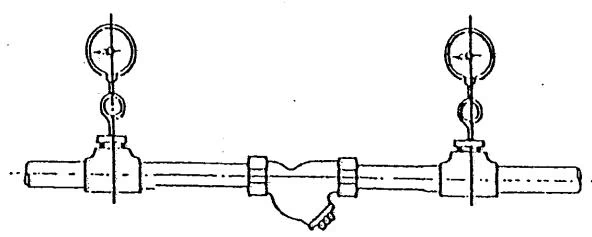
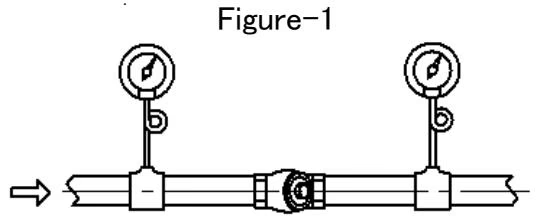
The SY-5 Strainer operates on a simple and efficient principle: fluid flows in from the strainer inlet side, passes through the stainless steel screen for filtration, where debris, iron slag, and other foreign matter are intercepted by the screen. The filtered clean fluid flows out from the outlet, protecting downstream piping and equipment from debris damage. By installing pressure gauges before and after the strainer, screen clogging can be determined based on pressure differential changes for timely cleaning and maintenance.

Selection Guide

Diameter Selection Principles

  1. Strainer diameter should match pipe diameter (pipe diameter = strainer diameter). Using undersized products will increase pressure loss and may cause insufficient inlet pressure for equipment.
  2. When selecting pipe diameter, consider fluid type, maximum flow rate, allowable pressure loss, and piping equipment costs:
    • Undersized pipe diameter: While reducing equipment costs, it increases pressure loss and may cause turbulence, increased friction velocity, and vibration.
    • Oversized pipe diameter: Increases equipment costs and heat loss.
  3. Refer to JIS standard flow velocities for pipe diameter selection. Standard flow velocities for various fluids are as follows:
FluidDescriptionStandard Velocity (m/s)
Saturated SteamVacuum or small diameter auxiliary pipes15 (10~20)
Saturated SteamLarge diameter30 (20~40)
Superheated SteamDiameter φ75~25040 (30~50)
Superheated SteamHigh-grade material pipes70 (65~80)
Steam Coil Inlet0.3~0.7MPa30 (25~30)
AirHigh pressure (above 1.0MPa)20 (20~25)
AirLow pressure15 (5~15)
AirVery low pressure (below 0.1MPa)10 (3~10)
Water, Oil-2 (2~4)

Note

The above table is based on JIS F7101 (Marine Engine Room Pipe Flow Velocity Standards). A safety factor of 20% above performance values is recommended for selection.

Pressure Loss Reference

For the SY-5 Strainer (standard screen: 80 mesh, hole count 2.5-7.21 holes/cm²) with water as the fluid, refer to the product pressure loss chart for the relationship between pressure loss and flow rate. Different nominal diameters have different flow-pressure loss characteristics; consult based on actual application scenarios.

Yoshitake SY-5 Pressure Loss Chart

Installation Instructions

Pre-Installation Precautions

  1. Confirm inlet/outlet direction and installation orientation during installation; incorrect direction will prevent proper operation.
  2. Adequate space must be provided for screen removal to facilitate subsequent cleaning and maintenance.
  3. Do not apply excessive load, bending, or vibration to the product when connecting pipes to avoid leakage.
  4. Remove debris and foreign matter from pipes before installation, and ensure sealing tape and liquid sealant used for pipe connections do not enter the piping to prevent product malfunction.
  5. Do not pipe dissimilar metals that create potential differences, as this will cause product or component corrosion.
  6. If absolutely no foreign matter passage is allowed, consult the manufacturer in advance.

Installation Requirements

  1. Installing pressure gauges before and after the strainer is recommended to determine screen clogging based on pressure differential.
  2. For standard installation, the bonnet should face downward; for steam applications, the bonnet should face sideways when connecting pipes to reduce condensate accumulation.
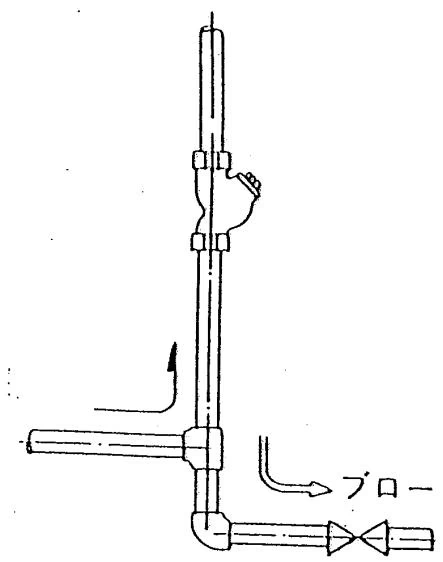
  3. For pipes with upward fluid flow, install a stop valve to discharge debris accumulated at the bottom.

Maintenance

Operating Precautions

Warning

  1. Do not touch the product directly by hand when fluid is at high temperature to avoid burns.
  2. When installed in sealed piping, be aware of volume expansion due to fluid temperature rise to avoid product damage.
  3. Do not turn the bonnet after fluid is flowing, as this may damage the gasket and cause external leakage.
  4. Avoid impacts from water hammer and other severe pressure fluctuations to prevent product and component damage.

Precautions

  1. Control pressure differential below 0.1MPa during operation and clean the screen regularly to prevent screen damage.
  2. The product structure cannot guarantee complete filtration of foreign matter equivalent to the indicated mesh size; select appropriate screen based on actual requirements.

Disassembly, Cleaning, and Assembly

Disassembly/Inspection Warning

Before disassembly and inspection, internal pressure in the product, piping, and equipment must be completely released. If fluid is at high temperature, allow cooling before work to avoid injury or burns from residual pressure.

Disassembly and Cleaning Steps

  1. After confirming no pressure in the strainer body using a pressure gauge, remove the bonnet and take out the screen.
  2. Use compressed air or water to flush the screen and remove debris.

Assembly Precautions

Precautions

  1. Clean the gasket contact surfaces of the body and bonnet before assembly; improper cleaning may cause fluid leakage at the gasket and burns.
  2. When reassembling, gaskets must be new; do not reuse old gaskets, as this will cause fluid leakage.
  3. Assembly sequence: Replace with new gasket and install on bonnet, fit the cleaned screen into the bonnet groove, then screw the bonnet into the body.