Ductile Cast Iron

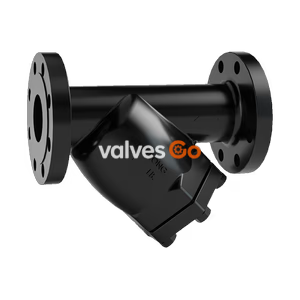
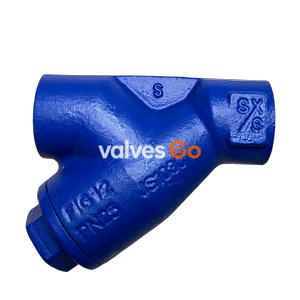
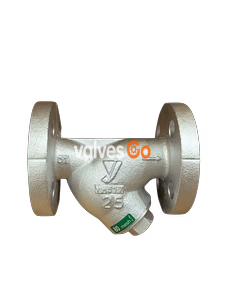
Yoshitake SU-20, SU-20S, and SU-20C ductile cast iron strainers for water and oil. Features large filtration area, JIS 10K FF flanged connection, and max 1.0 MPa pressure.
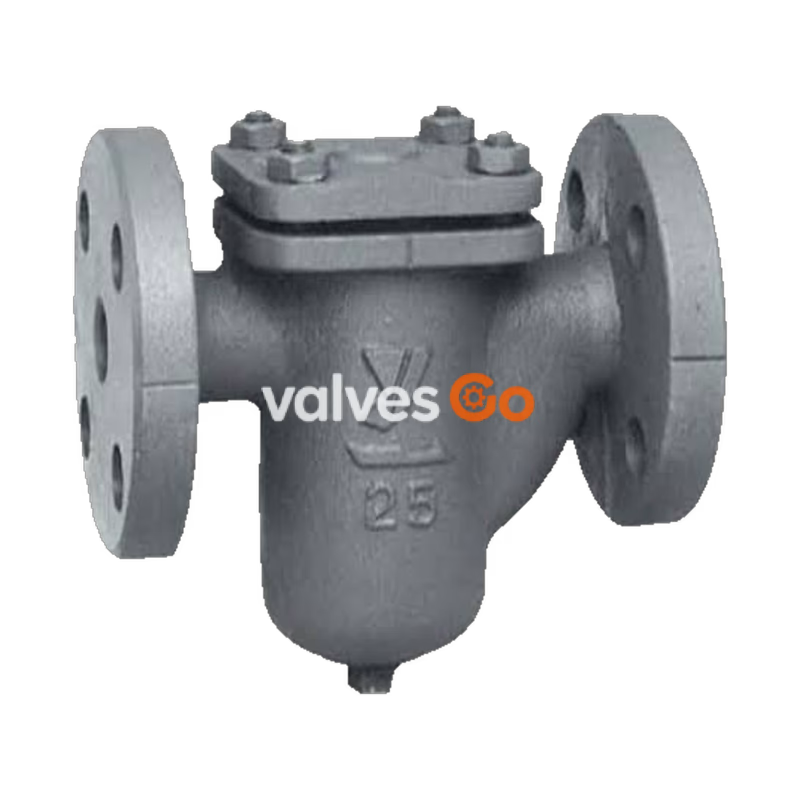
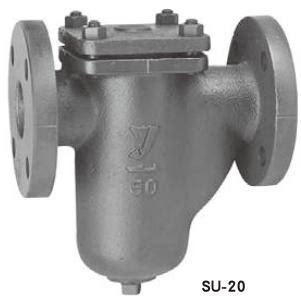
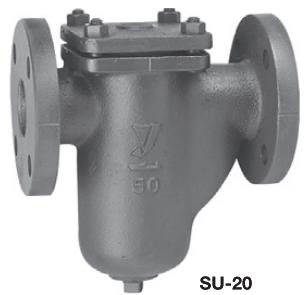
Yoshitake SU-20, SU-20S, and SU-20C are ductile cast iron strainers designed for removing dust and scale from cold and hot water, oil, and other non-dangerous fluids. They feature a large filtration area to minimize pressure loss and ensure sufficient flow. The series includes the standard SU-20, the SU-20S with a one-touch cover for easy maintenance, and the SU-20C which is coated with Nylon 11 for superior corrosion resistance.
| Specification | Value |
|---|---|
| Application | Cold and hot water, Oil (Kerosine, A and B heavy oil), Other non-dangerous fluids |
| Nominal size | 20A-150A |
| Maximum pressure | 1.0 MPa |
| Maximum temperature | 220°C (SU-20C: 60°C) |
| Body Material | Ductile cast iron |
| Screen Material | Stainless steel |
| Screen Perforation | $\phi$ 6-9P ($\phi$ 6-1.42 holes/cm²) |
| Screen Mesh | Standard 60 mesh |
| Connection | JIS 10K FF flanged |
| Specification | 20A-100A | 125A | 150A |
|---|---|---|---|
| Application | \multicolumn{3}{c | } | |
| Maximum pressure | 1.0 MPa | 0.7 MPa | 0.5 MPa |
| Maximum temperature | \multicolumn{3}{c | } | |
| Body Material | \multicolumn{3}{c | } | |
| O-ring | \multicolumn{3}{c | } | |
| Screen Material | \multicolumn{3}{c | } | |
| Screen Mesh | \multicolumn{3}{c | } | |
| Connection | \multicolumn{3}{c | } |
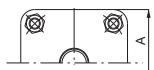
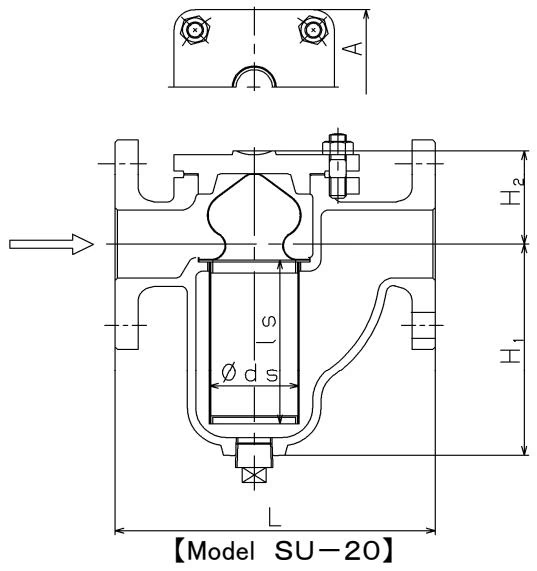
| Nominal Size | L | H1 | H2 | H3 | A | B | ds | ls | Plug | Weight (kg) SU-20/10 | Weight (kg) SU-20S/10S |
|---|---|---|---|---|---|---|---|---|---|---|---|
| 20A | 175 | 97.5 | 54 | 107.5 | 87 | 131 | 40 | 70 | R 3/8 | 5.0 | 5.6 |
| 25A | 175 | 97.5 | 54 | 107.5 | 87 | 131 | 40 | 70 | R 3/8 | 6.1 | 6.7 |
| 32A | 230 | 146 | 67.5 | 151 | 115 | 179 | 64.5 | 108 | R 3/4 | 11.1 | 12.5 |
| 40A | 230 | 146 | 67.5 | 151 | 115 | 179 | 64.5 | 108 | R 3/4 | 11.8 | 13.2 |
| 50A | 230 | 156 | 69.5 | 153 | 115 | 179 | 64.5 | 120 | R 3/4 | 12.4 | 13.8 |
| 65A | 290 | 182 | 70 | 153.5 | 134 | 208 | 77 | 140 | R 1 | 18.7 | 20.8 |
| 80A | 300 | 197.5 | 88.5 | 189 | 185 | 249 | 90 | 160 | R 1 | 23.8 | 27.1 |
| 100A | 365 | 262 | 118.5 | 253 | 220 | 334 | 120 | 210 | R 1-1/4 | 41.3 | 48.6 |
| 125A | 425 | 340.5 | 134.5 | 269 | 248 | 362 | 140 | 270 | R 1-1/2 | 61.4 | 69.4 |
| 150A | 505 | 378 | 158.5 | 293 | 305 | 414 | 175 | 300 | R 2 | 98.4 | 108.3 |
The nominal size of the strainer should be the same as that for the piping. Please note that if the nominal size of the strainer is smaller than that for the piping, the pressure loss of the strainer may grow, resulting in failure to maintain the required pressure at the inlet of the strainer.
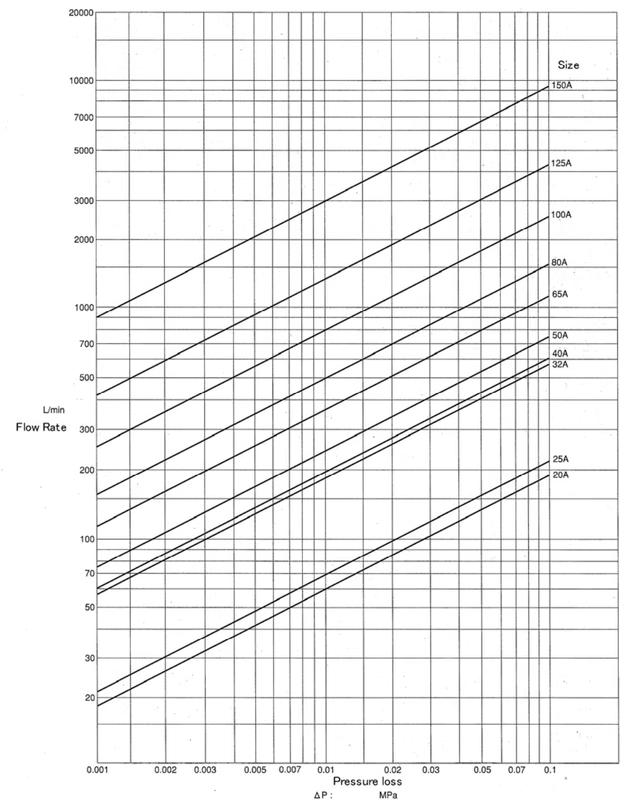
Standard flow velocity by fluid
| Fluid | Standard flow speed |
|---|---|
| Water & Oil | 2 m/s (2~4) |
Warning
As this product is heavy, please use a hanging device to securely support the product upon connection to the piping. Please note that falling of the product can result in injuries.
Cautions
Warning
Please make sure that there is no danger at the pipe end before pouring the fluid. You may get scalded in case hot fluid spouts out.
Caution
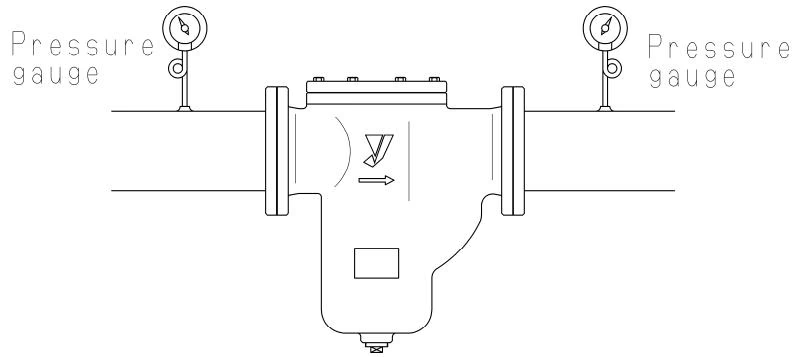
This product should be used only when the maximum pressure loss is 0.1MPa or less. Please also clean the screen regularly. Installation of pressure gauges at either end of the strainer enables to check the clogging of the strainer.
| Condition of failure | Causes | Measures and treatment |
|---|---|---|
| Fluid does not flow. | 1. Screen is clogged. 2. The stop valves at either end of the strainer are closed. | 1. Disassemble the strainer and clean screen. 2. Open the stop valve(s). |
| Loss of pressure is great. | 1. Screen is clogged. 2. The pressure gauge is out of order. 3. The nominal size is too small for the actual flow volume. | 1. Disassemble the strainer and clean screen. 2. Exchange the pressure gauge. 3. Use a strainer with a larger nominal size. |
| Alien matter is not removed. | 1. Screen is damaged. | 1. Disassemble the strainer and exchange screen. |
| Cover cannot be removed upon exchange of screen. | 1. The inside of the product is vacuum. 2. Cover and body are stuck together. | 1. Break the vacuum inside the pipe and remove cover. |
| Outer leakage occurs. | 1. O-ring is damaged. 2. Cover is not assembled properly. | 1. Install a new O-ring. 2. Assemble properly. |
After checking the pressure gauge so that there is no pressure inside the product, remove the nut (for SU-20, 20C) or the bolt (for SU-20S), cover and screen. Clean up the screen by air or detergent.
Warning
Remove all pressure within the product, piping, and equipment before disassembly and inspection. In case of hot fluid, cool down the product body so you can touch it with your bare hand before disassembly and inspection.
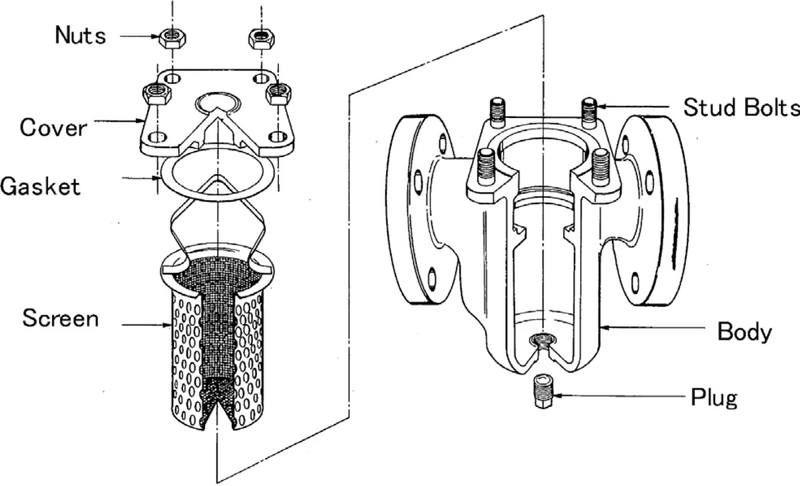
Note: The structure for SU-20S and 20C is different. Gaskets are consumable parts and should be replaced at disassembly.
Yoshitake Instrumentation / Strainers
SY, SU, SW, and ST series strainers for removing line debris and protecting downstream valves and equipment.