PN16

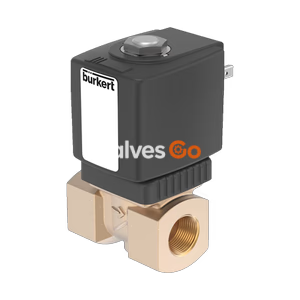
Burkert Type 2871 direct-acting 2-way proportional solenoid control valve. Features excellent range, compact design, and tight closing for demanding control tasks.
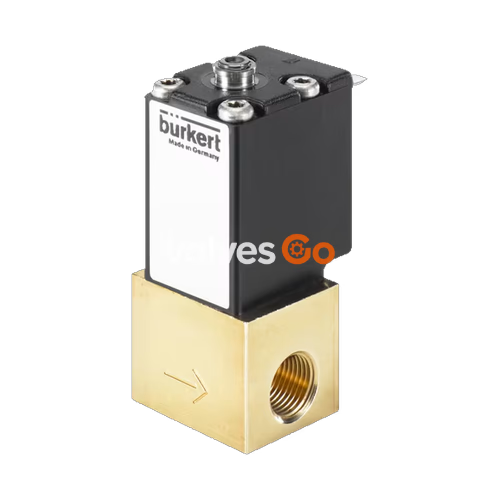
Burkert Type 2871 direct-acting solenoid control valve is used as the regulating unit in control loops. Due to an elastomeric seat seal, the valve closes tight (integrated shut-off function) up to the DN specific nominal pressure. The plunger of the valve is assembled frictionless, which leads to an extraordinary adjustment characteristic. This valve is particularly suitable for demanding control tasks such as high control range and dry gases.
Features include an excellent range, very good response, and a compact valve design. It is available in orifice sizes from 0.05 to 2.0 mm with port connections of 1/8" or sub-base.
| Product properties | |
|---|---|
| Seal material | FKM, EPDM |
| Body material | Brass, stainless steel |
| Hysteresis | < 5% |
| Repeat accuracy | < 0.25% FS |
| Response sensitivity | < 0.25% FS (< 0.1% FS with DN < 0.8 mm) |
| Setting range | 1:200 (DN 0.8...2), 1:500 (DN 0.05...0.6) |
| Actuating time (10...90%) | < 15 ms |
| Pressure range | 0...12 bar (also applicable for technical vacuum) |
| Duty cycle | 100% continuous operation |
| Operating voltage | 24 V DC (12 V on request) |
| Power consumption | Max. 5 W |
| PWM frequency | 1500 Hz (1000 Hz for high differential pressure variant) |
| Medium temperature | -10 °C...+90 °C (with FKM), -30 °C...+90 °C (with EPDM) |
| Viscosity | Max. 21 mm²/s (21 cSt) |
| Degree of protection | IP65 |
| Circuit function (CF) | Description |
|---|---|
| A | 2/2-way solenoid proportional control valve, direct-acting, normally closed |
Note
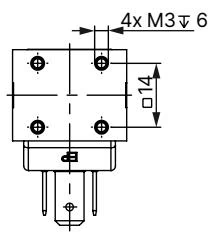
Dimensions in mm.
Determination of the Kv value:
| Pressure drop | Kv value for liquids [m³/h] | Kv value for gases [m³/h] |
|---|---|---|
| Sub-critical p2 > p1/2 | = Q √(ρ / 1000Δp) | = (QN / 514) √(T1ρN / p2Δp) |
| Supercritical p2 < p1/2 | = Q √(ρ / 1000Δp) | = (QN / 257p1) √(T1ρN) |
Reference Value
The dimensioning of the nominal diameter is very important for proportional valves to function properly within the application. The nominal diameter must be selected so that when the valve is fully open, a sufficient portion of the total pressure drop occurs across the valve.
Reference value: Δp_valve > 25% of the total pressure drop.
If the differential pressure (difference between inlet and outlet pressure) exceeds half the value of the nominal pressure, discontinuities may occur.
WARNING
Risk of injury due to high pressure and escaping medium. Switch off the pressure before working on the device or system. Vent or drain the pipes.
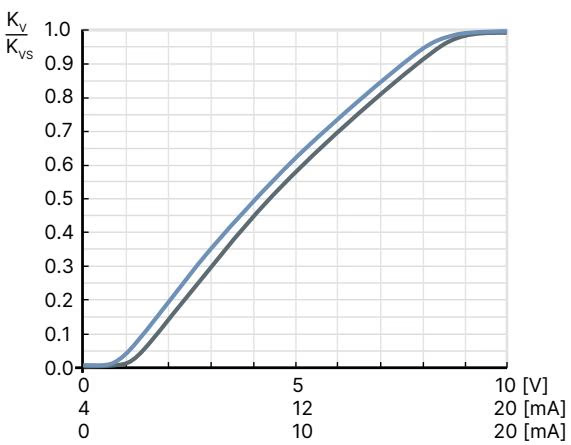
Valve control takes place through a PWM signal (pulse-width modulation). The duty cycle of the PWM signal determines the coil current and hence the position of the plunger.
PWM Frequency
For the standard variant, the PWM frequency is 1500 Hz. For the high differential pressure variant (e.g., SKU 238939), the PWM frequency is 1000 Hz. The setting range for the high differential pressure variant is 1:100.
Explore similar products in our catalog