Type 2032

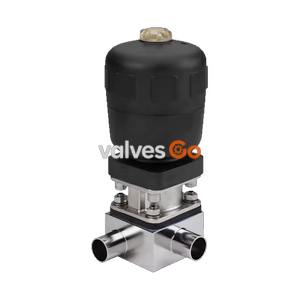
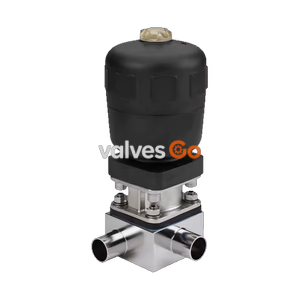
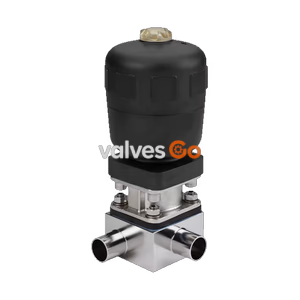
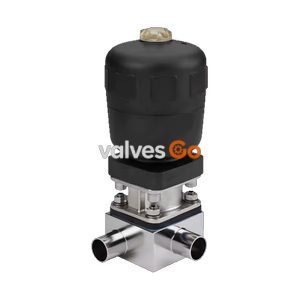
Burkert Type 2973 2/2-way manual diaphragm valve with plastic handwheel. Features a flow-optimized body, zero dead volume, and optional ATEX/IECEx approval.
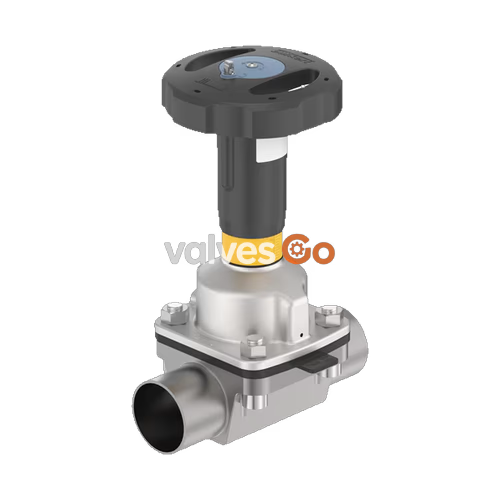
Burkert Type 2973 manually operated diaphragm valve consists of a manually operated actuator, a diaphragm, and a 2-way body. The manual actuator with a plastic handwheel ensures use in hygienic or aggressive ambient conditions. The flow-optimized valve body with minimum dead space enables high flow values and a wide range of possible applications. The valve body and the diaphragms are available in all common materials and variants. The actuator has a compact, autoclavable design and is compatible with all other Bürkert diaphragm valves.
The manual actuator possesses a visual position indicator with a reproducible stroke scale. The actuator also possesses an adjustable minimum and maximum stroke limitation and/or locking. The manual actuator can be optionally equipped with sensors for position feedback.
| Product Properties | Description |
|---|---|
| Forged steel valve body (VS) | Forged stainless steel 1.4435 in accordance with BN2 DIN EN 10222-5, F316L in accordance with ASTM A182/A182M and 316L in accordance with ASME BPE |
| Tube valve body (VP) | Stainless steel tube 1.4435-BN2 / UNS S31603 (316L) according to DIN 11866, ASTM A269 / A270, DIN EN 10217-7 / 10216-5 |
| Cast valve body (VG) | Stainless steel precision casting 1.4435 / 316L |
| Plastic valve body | PVC-C, PVC-U, PP, PVDF |
| Diaphragm | EPDM (AD), PTFE/EPDM (EA), Advanced PTFE/EPDM (EU), laminate of GYLON® and EPDM (ER) |
| Actuator | Stainless steel/PPS (diaphragm bonnet/handwheel) |
| Diaphragm size | 15...50 |
| Medium Data | Description |
|---|---|
| Operating medium | Neutral gases and liquids, highly purified, sterile, aggressive or abrasive mediums |
| Medium temperature (EPDM) | -10...+143 °C (steam sterilisation +150 °C for 60 min) |
| Medium temperature (PTFE/EPDM) | -10...+130 °C (steam sterilisation +140 °C for 60 min) |
Ambient Temperature
The ambient temperature for the actuator (Stainless steel/PPS) is -10 to +130 °C (short-term up to +150 °C), and it is autoclavable.
Explosion Protection (ATEX/IECEx)
Optional explosion protection is valid for the variable code PX51. As a category 2 device, it is suitable for zone 1/21 and zone 2/22.
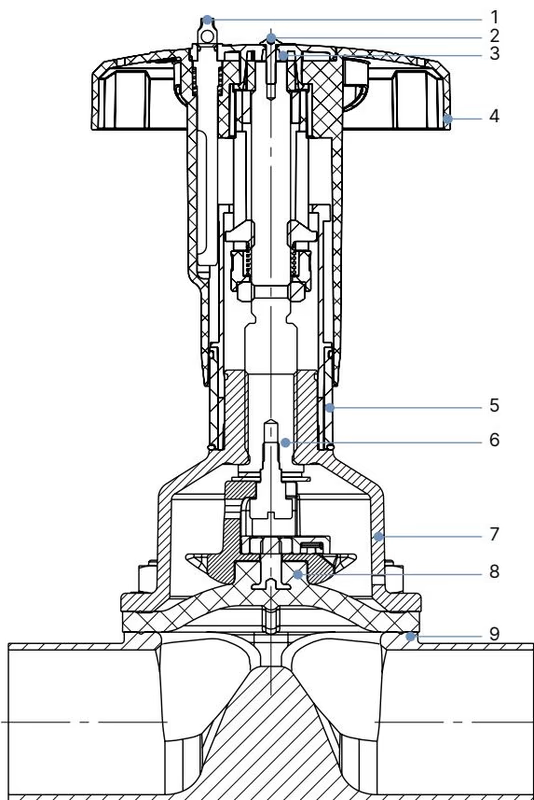
| No. | Element | Material |
|---|---|---|
| 1 | Lock pin | Stainless steel 1.4305 |
| 2 | Screw | Stainless steel A2 |
| 3 | Handwheel cover | Polyamide (PA) |
| 4 | Handwheel | Polyphenylene sulphide (PPS) |
| 5 | Visual position indicator | Polyamide (PA) |
| 6 | Valve spindle | Stainless steel 1.4305 |
| 7 | Diaphragm socket | Stainless steel 1.4308 |
| 8 | Diaphragm | EPDM, PTFE/EPDM, Advanced PTFE/EPDM, Laminate of GYLON® and EPDM |
| Diaphragm size [mm] | Port connection [inch] | Kv value water [m³/h] (DIN EN ISO 1127) | Kv value water [m³/h] (ASME BPE) |
|---|---|---|---|
| 15 | 1/2 | 6.5 | 3.1 |
| 20 | 3/4 | 12.5 | 8.4 |
| 25 | 1 | 18 | 15.5 |
| 40 | 1 1/2 | 41 | 37 |
| 50 | 2 | 66 | 66 |
Note on Flow Characteristics
The Kv values may vary slightly for different diaphragm materials. Measurement at +20 °C, 4 bar at valve inlet and 3 bar at valve outlet.
| Diaphragm size | Maximum static operating pressure [bar] | Tightening torque EPDM/FKM [Nm] | Tightening torque PTFE [Nm] |
|---|---|---|---|
| 15 | 10 | 0.8 | 1.7 |
| 20 | 10 | 0.9 | 3.0 |
| 25 | 10 | 1.2 | 3.5 |
| 32 | 10 | 2.5 | 4.0 |
| 40 | 10 | 4.5 | 7.0 |
| 50 | 10 | 6.0 | 11.0 |
A minimum and maximum stroke limit can be set for Type 2973 (diaphragm sizes 15…50). The stroke limit is available as an option and is not integrated as standard. An adjusting sleeve is used for this purpose.
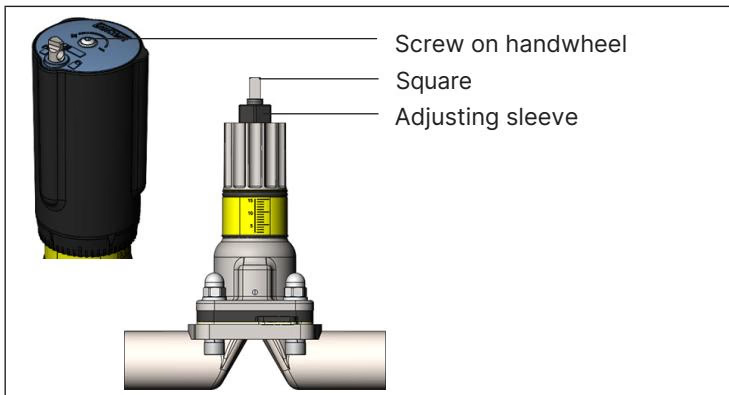
For Type 2973 (diaphragm size 15…50), a locking mechanism is available as an option to prevent accidental or unauthorised operation.
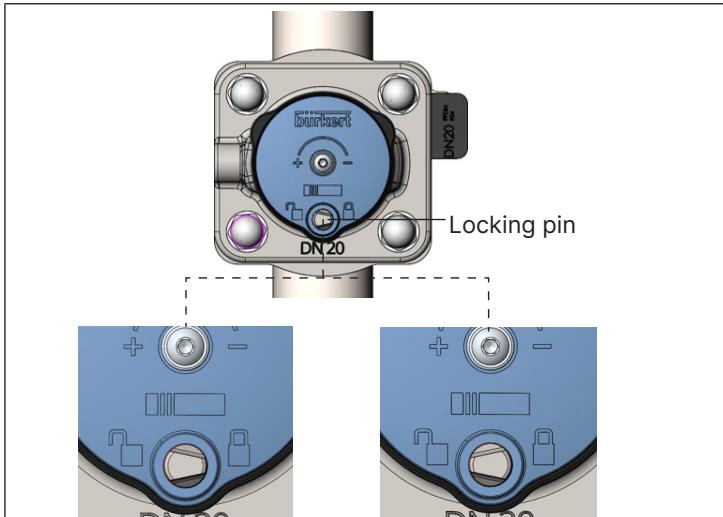
Push the locking pin down and rotate by 180° (either clockwise or anticlockwise). It may be necessary to turn the handwheel slightly so that the locking pin reaches its end position. Insert a padlock through the bore in the locking pin and secure it.
Explore similar products in our catalog