Teach Function

Burkert Type 8605 digital control electronics convert analogue signals to PWM for proportional valves. Features adjustable frequency, internal current control, and optional büS communication.
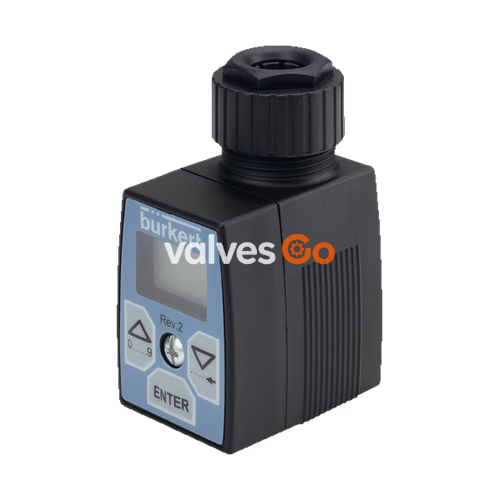
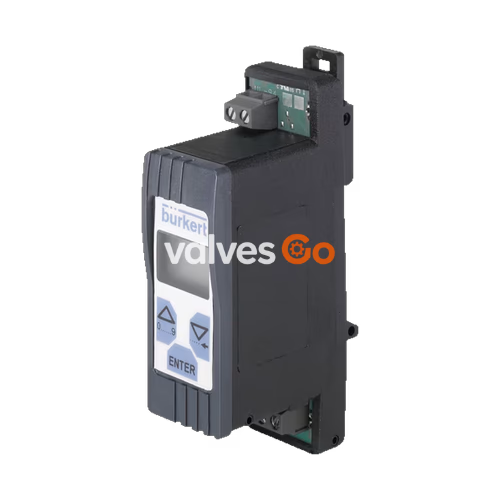
Burkert Type 8605 digital control electronics are used to operate proportional solenoid control valves in a power range from 40 to 2000 mA. The electronics convert an external standard signal into a pulse-width modulated (PWM) signal, which enables infinite adjustment of the opening of the proportional valve and hence a fluidic output parameter such as flow rate. An internal current control with the duty cycle of the PWM signal as an actuating variable ensures that every value of the input signal, irrespective of the thermal state of the coil, is unambiguously assigned a given value of the effective coil current.
A display and operating keys allow the electronics to be easily adapted to a particular proportional valve and to the specific conditions of an application. In order to integrate the control unit into a higher-level controller, the CAN-based variant of the control unit (called büS) is required.
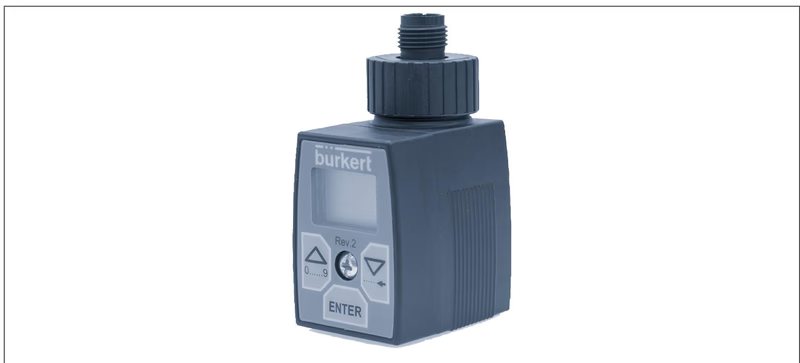
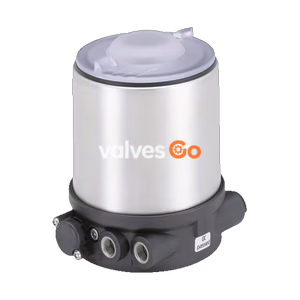
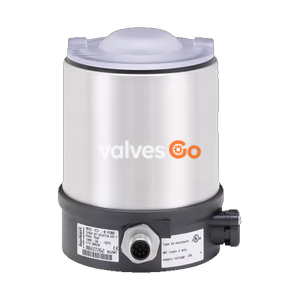
Cable plug version: Plug-in version on valves with connector pattern A. The operating unit can be removed after the setting process. During operation without the operating unit, the operating status is indicated by two LEDs.
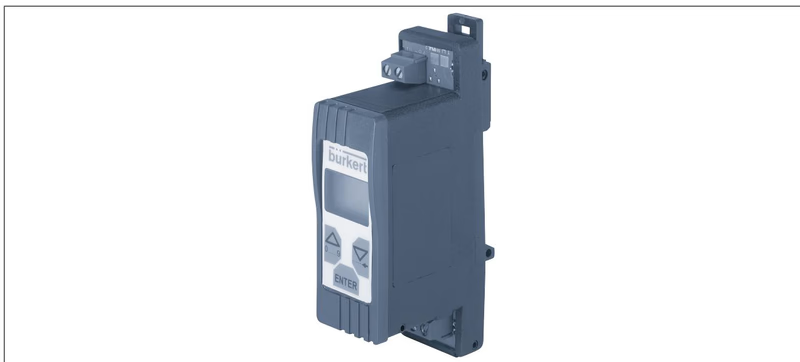
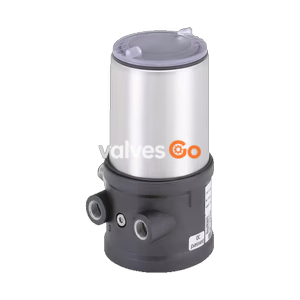
DIN rail version: Separate electronics in housing for DIN rail mounting to DIN EN 50022. This form is suitable for all proportional valves in the indicated current range. The operating unit cannot be removed.
| Product properties | Analogue variant | büS variant |
|---|---|---|
| Output signal | PWM signal: frequency adjustable from 80 Hz to 6 kHz | PWM signal: frequency adjustable from 80 Hz to 6 kHz |
| Output current | PWM: max. 2 A | PWM: max. 2 A |
| Operating voltage | 12...24 V DC | 12...24 V DC |
| Input signal | 0...20 mA, 4...20 mA or 0...5 V, 0...10 V | Digital control via CANopen based system bus (büS) |
| Power consumption | Approx. 1 W (without valve) | Approx. 1 W (without valve) |
| Degree of protection | IP65 (Cable plug), IP40 (Standard rail) | IP65 (Cable plug) |
| Ambient temperature | -10 °C...+ 60 °C | -10 °C...+ 60 °C |
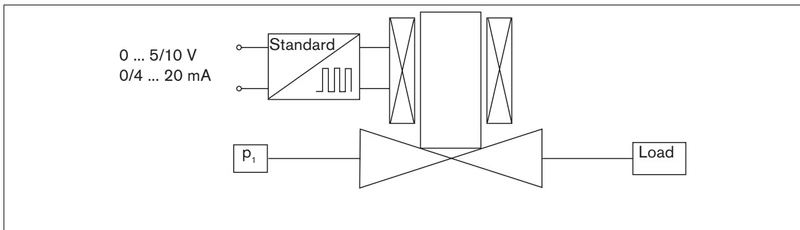
Basic Function: The control electronics transform an external standard signal into a PWM voltage signal supplied to the solenoid coil. Due to the inductivity of the coil, the rectangular time curve of the PWM voltage signals is transformed into a sawtooth-like rounded time curve. The mean coil current depends on the pulse duty factor of the voltage signal.
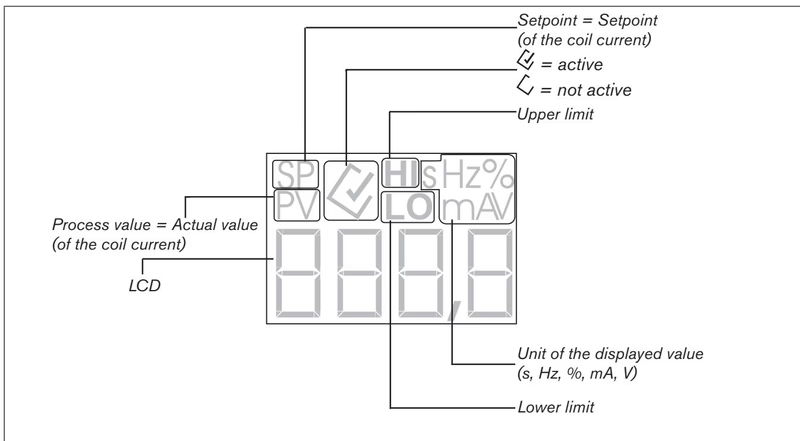
Operating Unit: Consists of an LCD and keys used for displays and settings. It allows adjustment of the minimum and maximum current (opening start or full opening) to the actual pressure conditions.
TIP
To ensure that the device functions perfectly, set the PWM frequency which is suitable for the valve. The valve reacts more sensitively when the working point has average pulse duty factors and more slowly in the limit areas close to 0% or 100%.
Ramp Function: Serves to attenuate sudden changes in the input signal and transform them into an adjustable ramp (time constant 0 to 10 s).
Zero Point Cut-off: Guarantees the leak-tight closing of the valve at input signals below a given threshold (e.g., < 2% of the limit value). The coil current is set to zero so that the full force of the return spring acts as a closing force.
Explore similar products in our catalog